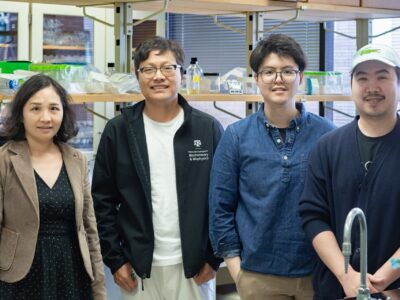
James C. Hu
Associate Professor of Biochemistry and Biophysics
Faculty of Genetics
Chemistry/Biology Interface Training Program
Phone: (979) 862-4054
Email: jimhu@tamu.edu
Visit the Hu lab Home Page
B.S. Stanford University (1975)
Ph.D. University of Wisconsin (1987)
Postdoc. Massachusetts Institute of Technology (1987-92)
Joined Texas A&M faculty in 1992
|
Protein interactions/Microbial Genomics and Annotation
|
Multisubunit proteins are involved in every aspect of life. We use biochemical, biophysical, genomic, and molecular genetic approaches to identify and study protein interactions. We are studying two families of proteins to understand how the specificity of assembly is used to distinguish proteins with similar tertiary structures. Leucine zippers are short alpha-helical coiled-coils that hold together the dimers in many eukaryotic transcription factors. LysR-Type Transcriptional Regulators (LTTRs), which form homotetramers, are one of the most common types of bacterial transcription factors. Understanding how leucine zippers and LTTRs form specific homo- and heterooligomers will help us understand the principles of protein architecture and evolution, and may allow us to develop new tools to modulate gene expression.
We are also using a genetic approach to screen whole genomes for new oligomeric proteins and protein domains. We have identified hundreds of oligomerization domains from E. coli, the yeast Saccharomyces cerevisiae, and two important bacterial pathogens, Mycobacterium tuberculosis and Pseudomonas aeruginosa. We are using these domains to develop new approaches to functional genomics and the discovery of new antibiotics based on blocking the assembly of specific protein complexes.
Our genome-wide studies of protein interactions and E. coli proteomics have led us to appreciate the importance of continuous updating of genome annotation, We are using "new media" to build systems for the scientific community to participate in updating the annotation of every gene from any organism (but with special focus on E. coli).
EcoliWiki an be thought of as "Wikipedia for E. coli", while the Gene Ontology Normal Usage Tracking System (GONUTS) is a wiki to allow scientists to use and understand the Gene Ontology system for functional annotation.
|
Recent Publications
|
- Knapp GS & Hu JC (2009) The oligomerization of CynR in Escherichia coli. Protein Sci 18: 2307-15
- Hu JC, Karp PD, Keseler IM, Krummenacker M & Siegele DA (2009) What we can learn about Escherichia coli through application of Gene Ontology. Trends Microbiol 17: 269-78
- Knapp GS, Tsai JW & Hu JC (2009) The oligomerization of OxyR in Escherichia coli. Protein Sci 18: 101-7
- Hu JC, Aramayo R, Bolser D, Conway T, Elsik CG, Gribskov M, Kelder T, Kihara D, Knight TF Jr, Pico AR, Siegele DA, Wanner BL & Welch RD (2008) The emerging world of wikis. Science 320: 1289-90
- Fischer TB, Holmes JB, Miller IR, Parsons JR, Tung L, Hu JC & Tsai J (2006) Assessing methods for identifying pair-wise atomic contacts across binding interfaces. J Struct Biol 153: 103-12
- Mariño-Ramírez L, Minor JL, Reading N & Hu JC (2004) Identification and mapping of self-assembling protein domains encoded by the Escherichia coli K-12 genome by use of lambda repressor fusions. J Bacteriol 186: 1311-9
- Champion MM, Campbell CS, Siegele DA, Russell DH & Hu JC (2003) Proteome analysis of Escherichia coli K-12 by two-dimensional native-state chromatography and MALDI-MS. Mol Microbiol 47: 383-96
- Mariño-Ramírez L, Campbell L & Hu JC (2003) Screening peptide/protein libraries fused to the lambda repressor DNA-binding domain in E. coli cells. Methods Mol Biol 205: 235-50
- Mariño-Ramírez L & Hu JC (2002) Isolation and mapping of self-assembling protein domains encoded by the Saccharomyces cerevisiae genome using lambda repressor fusions. Yeast 19: 641-50
- Hu JC (2001) Model systems: Studying molecular recognition using bacterial n-hybrid systems. Trends Microbiol 9: 219-22
- Zhu H, Celinski SA, Scholtz JM & Hu JC (2001) An engineered leucine zipper a position mutant with an unusual three-state unfolding pathway. Protein Sci 10: 24-33
- Hu JC (2000) A guided tour in protein interaction space: coiled coils from the yeast proteome. Proc Natl Acad Sci U S A 97: 12935-6
- Rieker JD & Hu JC (2000) Molecular applications of fusions to leucine zippers. Methods Enzymol 328: 282-96
- Kopytek SJ, Dyer JC, Knapp GS & Hu JC (2000) Resistance to methotrexate due to AcrAB-dependent export from Escherichia coli. Antimicrob Agents Chemother 44: 3210-2
- Hays LB, Chen YS & Hu JC (2000) Two-hybrid system for characterization of protein-protein interactions in E. coli. Biotechniques 29: 288-90, 292, 294 passim
- Zhu H, Celinski SA, Scholtz JM & Hu JC (2000) The contribution of buried polar groups to the conformational stability of the GCN4 coiled coil. J Mol Biol 300: 1377-87
- Siegele DA, Campbell L & Hu JC (2000) Green fluorescent protein as a reporter of transcriptional activity in a prokaryotic system. Methods Enzymol 305: 499-513
- Hu JC, Kornacker MG & Hochschild A (2000) Escherichia coli one- and two-hybrid systems for the analysis and identification of protein-protein interactions. Methods 20: 80-94
- Zeng X, Zhu H, Lashuel HA & Hu JC (1997) Oligomerization properties of GCN4 leucine zipper e and g position mutants. Protein Sci 6: 2218-26
- Siegele DA & Hu JC (1997) Gene expression from plasmids containing the araBAD promoter at subsaturating inducer concentrations represents mixed populations. Proc Natl Acad Sci U S A 94: 8168-72
|